The zone editor’s documentation is fairly sparse, but at least it’s available on the web now:
New Editor Builds
For this build, version 0.59, the name has been changed from “Basternae Editor” to “ModernMUD Editor”. This is because I’m in the process of open-sourcing the codebase, and the editor will work not only for Basternae, but any MUD based on the same codebase.
Other than the name change, there are a few stability fixes, and probably some new bugs. Download links for Windows and OSX/Linux are on the right side of the blog. Enjoy!
Parallel Programming and Cryptocurrencies
Lately I’ve been spending a lot of brain cycles learning parallel programming tools and APIs. These are tools that let you write code to run on your video card (GPU) and/or multiple CPU cores at once. I’ve learned the basics of NVIDIA CUDA, OpenCL, OpenMP, and C++ AMP over the past few weeks. They’re neat things to know, but I’m not really sure what I’d use them for since most of the applications are scientific computing and math-intensive things and that’s not something I’ve ever really focused on.
One of the most useless things that GPUs are used for is mining bitcoins and litecoins. They’re a virtual currency that is created by using math to turn lots of electricity into coins that are worth anywhere from slightly less to a lot less than you paid for the electricity. This imaginary currency will gradually disappear as governments obliterate the exchanges that you can trade them on. They’re doing that because alternative currencies are a threat to them – they’re hard to tax, easy to launder, and undermine the authority of a central bank. These are all generally good things unless you’re a government. Bitcoins and litecoin wallets and exchanges are also frequently hacked/robbed, but nobody knows yet whether those thieving hackers are government-sponsored.
Now that I’ve made it clear that cryptocurrencies are dumb, one thing they are great for is exploring and learning about the capabilities of different hardware and parallel computing APIs. There are plenty of open source mining programs that use CUDA, OpenCL, or CPU-based hash calculations, and you can run a miner on almost anything. If you want to waste electricity, you’ve got options.
I have a wide range of hardware at home and have benchmarked quite a few things. Here are the speeds of various bits of hardware in Litecoin kilohashes per second:
460 hashes/sec – Asus EEE 701 PC with 630 MHz single-core Celeron processor.
1500 hashes/sec – HP Touchpad Tablet with 1.2 GHz dual-core ARM processor.
6200 hashes/sec – Compaq laptop with Core 2 Duo T8100 processor.
13650 hashes/sec – NVIDIA Geforce GT 610 512MB PCI video card.
27400 hashes/sec – NVIDIA Geforce GT 650M 2GB laptop video card.
37000 hashes/sec – AMD Phenom II 1100T six-core processor.
41000 hashes/sec – MSI laptop with i7-3920XM quad-core processor.
52000 hashes/sec – NVIDIA Geforce 640 1GB PCI-E video card.
NULL hashes/sec – ATI Radeon HD 6870 1GB PCI-E video card.
I don’t have much ATI graphics hardware, and for good reason, because one thing is still true – there is *ALWAYS* something broken in their drivers, and in the case of my 6870, OpenCL doesn’t work right on it, so it’s pretty much a brick for this experiment.
The most interesting bit was getting a litecoin miner running on my HP Touchpad. There is a miner daemon called “Pooler’s CPUMiner” that can be compiled for ARM. It almost compiled with the TouchPad SDK, but it required some adjustments to library settings and compile flags to get it to work. After a bit of tinkering I got it to run on the device at a blistering 1510 hashes per second. When the device’s screen is off the CPU runs at half speed, so with the screen off it gets 760 hashes per second. Because I know the masses will be clamoring for a TouchPad binary, I’ve posted it on Github: https://github.com/Xangis/cpuminer
This was an interesting experiment and I’ve managed to generate nearly 10 cents in imaginary money. It only took just over $1 of electricity to get there.
The Magma Codebase Is Worth Millions!
I love how Ohloh estimates the value of open source projects. For instance, here’s their take on the Magma MUD codebase:
I believe Envy is just over 100k lines of code. At the average developer salary of $91,000/year, about $1 million in “value” was created by the Basternae II rebuild team. Value that, due to the DikuMUD license, could never actually be “claimed” through any means.
Just a curiosity, really, but still fun.
Sniktiorg’s Zones
Sniktiorg, one of the most creative and prolific zone creators in the world of MUDs, has granted Basternae 3 permission to use his areas. Woohoo!
I’ll attach them as I get them converted to the new format and figure out where in the world they should go.
Preserving Newlines in XML Serialization
With .NET’s XML serialization, it kills newlines when you serialize XML to disk. More specifically, it converts a CR+LF into just an LF (\r\n becomes just \n).
This was causing annoyances with the spell editor, since you can edit source code for spells with it, but the code would appear all on one line after saving and reloading.
The fix was to declare XmlWriterSettings with a newline preference.
The code was this:
         public void Save()
         {
             XmlSerializer serializer = new XmlSerializer(GetType());
             Stream stream = new FileStream(FileLocation.SpellDirectory + FileName,
                 FileMode.Create, FileAccess.Write, FileShare.None);
             serializer.Serialize(stream, this);
             stream.Close();
         }
And now it’s this:
        public void Save()
        {
            XmlWriterSettings ws = new XmlWriterSettings();
            ws.NewLineHandling = NewLineHandling.Entitize;
            XmlSerializer serializer = new XmlSerializer(GetType());
            Stream stream = new FileStream(FileLocation.SpellDirectory + FileName,
                FileMode.Create, FileAccess.Write, FileShare.None);
            XmlWriter writer = XmlWriter.Create(stream, ws);
            serializer.Serialize(writer, this);
            stream.Close();
        }
I can have my newlines and eat them too. Oh joy!
I Am Addicted To Github
Until recently, the only code I’ve released as open source has been the Magma MUD codebase.
In the process of posting the Magma source on Github, I kind of got hooked on posting code online. Since then I’ve posted the source for a handful of applications, a mix of Linux and Windows desktop apps. A 12-day commit streak so far, yay!
I’m also considering open-sourcing the Basternae 3 codebase. The main things that make it easier to work with than old-timey C-based MUDs are the use of C#, which has amazing exception handling and debugging capabilities (no more attaching gdb to a core dump), and speaks XML natively, so data files are Human-readable, portable, fairly robust, and extensible. The editor is also getting to be pretty good.
To open source Bast3, I’d need to write a lot more documentation, and I’d need to “genericize” a lot of things that are specific to Basternae. It’d be a lot of work, but I think it’d be a fun project. The source is already in a private repository on Github, but that’s the easy part.
More Stability Improvements
I fixed a few more glitches, and the MUD seems to be a lot more stable. Bang on it, see if you can break it! First one to crash the MUD gets a cookie.
Things Were Brokenated For A Bit
Something went horribly wrong with the communication code, so logging in wasn’t possible for a few days. All is well now.
Magma MUD Codebase Now on Github
The Magma MUD codebase, last updated in 2008, is now on Github: https://github.com/Xangis/magma
I’ve cleaned up the build a little bit, but it’s still the same old Magma that was used to start Basternae 2, warts and all.
If you feel like cleaning up any bugs (there are plenty) or adding any improvements, go ahead. If you want to send a pull request I’m Xangis on Github (as you can probably tell from the URL).
MonoDevelop Not So Great
It turns out that using MonoDevelop had some dangerous side effects, especially related to terminal output.
Mobs in your current room were rendered invisible on the Mono build even though they were visible on scan and you could attack them if you knew they were there. It’s back to using Visual Studio in a Windows 8 VM.
Using MonoDevelop
I’ve almost always used both Windows and Linux, but I stopped using Windows a few months ago. One of the things that only runs on a Windows machine is Visual Studio. The Basternae code was compiled on a Windows machine and then uploaded to the Linux host.
Without access to that, it was time to try using MonoDevelop.

It was able to load the Visual Studio solution, with some exceptions: The client WPF project didn’t load, nor did the abandoned Silverlight project. I could probably install more packages to make WPF work, I’m not sure yet.
I noticed that the compiler works differently for some things, like terminal characters. The ECHO_ON and ECHO_OFF sequences broke logging in, but some weird prompt formatting that’s been around for a while just fixed itself. It will be interesting to see what other diffferences turn up. Even though C# is supposed to work the same on all platforms, I suspect that it might work better when both the build and run machines have the same operating system.
Server’s Up
I started the server back up. Feel free to log in.
What of the MUD?
That is a good question. I haven’t touched it in a long time, around a year.
Basternae is still important, but it’s been pretty severely deprioritized in favor of the startup work I’ve been doing here in the Portland area. As soon as I get a win big enough to retire on it’ll be my first priority, I promise.
Can you think of a way I can make a living writing a MUD? I’ve been trying for 10 years, but haven’t come up with anything. That’s a shame because it’s far more fun than doing almost any kind of real work.
Mint Mark Guide
From my website stampscoinsnotes.com. The meanings of mint marks on coins from different countries.
Germany
A – Berlin
D – Munich
E – Muldenhutten
F – Stuttgart
G – Karlsruhe
J – Hamburg
Mexico
A – Alamos
AS – Alamos
C – Culiacan
CA – Chihuahua
CE – Real de Catorce
CH – Chihuahua
Cn – Culiacan
D – Durango
Do – Durango
G – Guanajuato
Ga – Guadalajara
GC – Guadeloupe y Calvo
Go – Guanajuato
H – Hermosillo
Ho – Hermosillo
M – Mexico City
Mo – Mexico City
O – Oaxaca
OA – Oaxaca
P – San Luis Potosi
PI – San Luis Potosi
SLP – San Luis Potosi
Z – Zacatecas
Zs – Zacatecas
United Kingdom
H – Heaton
KN – King’s Norton
United States
C – Charlotte
CC – Carson City
D – Denver
O – New Orleans
P – Philadelphia
S – San Francisco
W – West Point
Country Identifier
From my website stampscoinsnotes.com. This may help in identifying stamps or currency.
Afghanes – Afghanistan
Al-Maghrib – Morocco
Batavia – Netherlands Indies
Bon Towarowy – Poland
Cabo Verde – Cape Verde
CCCP – Russia (Soviet era)
Ceskoslovensko – Czech Republic
CPBNJA – Serbia
CRVENI KRST – Yugoslavia
Deutsche Bundepost – Germany
D.P.R. Korea – North Korea
Eire – Ireland
Foroyar – Faroe Islands
Haute Volta – Upper Volta
Helvetia – Switzerland
HP BbArAPNR – Bulgaria
Hrvatska – Croatia
Island – Iceland
JYROCNABHJA – Yugoslavia
Kampuchea – Cambodia
Kibris – Cyprus
Letzeburg – Luxembourg
Lietuva – Lithuania
Magyar – Hungary
MAKEDOHNJA – Macedonia
Malgache – Madagascar
MOHROA WYYAAH – Mongolia
Muntbiljet – Suriname
Nippon – Japan
Noreg – Norway
Noyta – Russia
Osterreich – Austria
Persane – Iran
Poccir – Russia
Republica Dominicana – Dominican Republic
Santral Sesel – Seychelles
Shqiperia – Albania
Srpske Krajine – Serbian Krajina
Suomen – Finland
Sverige – Sweden
Togolaise – Togo
TOYNKNCTOH – Tajikistan
UAPCTBO – Bulgaria
UPHETOPE – Montenegro
Zhongguo – China
Aitutaki – New Zealand
AZERBAYCAN – Azerbaijan
Belgique – Belgium
Bundeskassenschein – Germany
Cambodge – Cambodia
Ceska – Czech Republic
Comores – Comoros
CPNCKA – Serbia
DDR – German Democratic Republic
Deutsche Demokratische Republik – German Democratic Republic
Eesti – Estonia
Espana – Spain
Gronland – Greenland
Heireann – Ireland
Helvetica – Switzerland
HP GbNraPNR – Bulgaria
Inrikes – Sweden
Jugoslavija – Yugoslavia
KA3AKCTAK – Kazakhstan
KbIPTbI3CTAH – Kyrgyzstan
Kyrgyz – Kyrgyzstan
Liban – Lebanon
Lietuvos Respublika – Lithuania
MAKEAOHCKN – Macedonia
Malagasy – Madagascar
Maroc – Morocco
Moldovei – Moldova
Nederland – Netherlands
Nistriana – Transnistria
Norge – Norway
Noytobar Mapka – Russia
PCCP – Russia
Pilipinas – Philippines
Polski – Poland
RSA – South Africa
Sedlabanki Islands – Iceland
Shqiptar – Albania
Suid-Afrika – South Africa
Suomi – Finland
Tchad – Chad
TOrPOr – Mongolia
Turkiye – Turkey
UPHA rOPA – Montenegro
YKPAIHN – Ukraine
Number Identifier
From my old website stampscoinsnotes.com, numbers in different languages.
| Language | 0 | 1 | 2 | 3 | 4 | 5 | 6 | 7 | 8 | 9 |
|---|---|---|---|---|---|---|---|---|---|---|
| Arabic | ٠ | ١ | ٢ | ٣ | ٤ | ٥ | ٦ | ٧ | ٨ | ٩ |
| Bengali | ০ | ১ | ২ | ৩ | ৪ | ৫ | ৬ | ৭ | ৮ | ৯ |
| Burmese (Myanmar) | ၀ | ၁ | ၂ | ၃ | ၄ | ၅ | ၆ | ၇ | ၈ | ၉ |
| Devanagari (Hindi/Nepali) | ० | १ | २ | ३ | ४ | ५ | ६ | ७ | ८ | ९ |
| Ethiopic | ፩ | ፪ | ፫ | ፬ | ፭ | ፮ | ፯ | ፰ | ፱ | |
| Gujarati | ૦ | ૧ | ૨ | ૩ | ૪ | ૫ | ૬ | ૭ | ૮ | ૯ |
| Hebrew | א | ב | ג | ד | ה | ו | ז | ח | ט | |
| Japanese (Chinese/Vietnamese) | 〇 | 一 | 二 | 三 | 四 | 五 | 六 | 七 | 八 | 九 |
| Kannada | ೦ | ೧ | ೨ | ೩ | ೪ | ೫ | ೬ | ೭ | ೮ | ೯ |
| Khmer | ០ | ១ | ២ | ៣ | ៤ | ៥ | ៦ | ៧ | ៨ | ៩ |
| Lao | ໐ | ໑ | ໒ | ໓ | ໔ | ໕ | ໖ | ໗ | ໘ | ໙ |
| Malayalam | ൦ | ൧ | ൨ | ൩ | ൪ | ൫ | ൬ | ൭ | ൮ | ൯ |
| Oriya | ୦ | ୧ | ୨ | ୩ | ୪ | ୫ | ୬ | ୭ | ୮ | ୯ |
| Punjabi (Gurmukhi) | ੦ | ੧ | ੨ | ੩ | ੪ | ੫ | ੬ | ੭ | ੮ | ੯ |
| Tamil | ௧ | ௨ | ௩ | ௪ | ௫ | ௬ | ௭ | ௮ | ௯ | |
| Telugu | ౦ | ౧ | ౨ | ౩ | ౪ | ౫ | ౬ | ౭ | ౮ | ౯ |
| Thai | ๐ | ๑ | ๒ | ๓ | ๔ | ๕ | ๖ | ๗ | ๘ | ๙ |
| Tibetan | ༠ | ༡ | ༢ | ༣ | ༤ | ༥ | ༦ | ༧ | ༨ | ༩ |
| Urdu (Persian/Farsi) | ۰ | ۱ | ۲ | ۳ | ۴ | ۵ | ۶ | ۷ | ۸ | ۹ |
Cleaning Old Coins
Old coins often have dirt, corrosion, oil, or other “gunk” on them. It can be tempting to clean them with powerful industrial cleaners, silver polish, Shine Brite, or other chemical cleaners.
However, this is a bad idea.
Over time, coins develop oxidation, discoloration, and a layer of grime. This is called a patina, or more commonly in numismatics, toning.
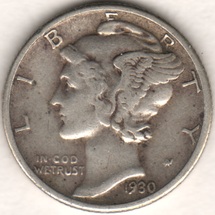
Natural Toning on a Mercury Dime.
Chemical cleaning agents will remove toning. A coin in its natural toned state is more valuable, so removing toning will reduce a coin’s value and collectibility. An ugly old coin may not look as appealing to most people, but a shiny, artificially new-looking coin from the 1920s with a noticeably worn face is unappealing to an experienced collector.
It is possible to add false toning to a chemically cleaned coin with something like Midas Black Max Oxidizer, which uses hydrochloric acid and tellurium to create an artificial patina. This is technically a form of counterfeiting and is not recommended, as it renders a coin numismatically worthless. It may be a fine choice when recovering corroded old coins to turn into jewelry, but that is the only sane use for such a thing.
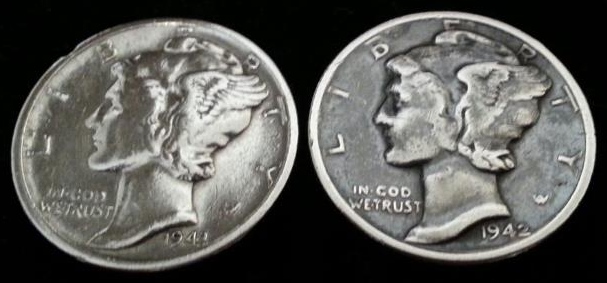
Cleaned and False-Toned Mercury Dimes for Use in Jewelry Manufacture. Image Courtesy of Dean Moore Designs.
The only safe way to clean a coin is with a gentle wash in mild dish soap and water. If that can’t remove the excess grime from your coin, then it wasn’t meant to be removed.
Coins should be washed by hand in a plastic container, because rubbing them against a metal sink can scratch them, as can some cleaning pads and brushes. Using steel wool to clean coins would be an especially bad idea. Rub the coin with your fingers from the center outward to push dirt, oil, and grime toward the edge of the coin.
After washing, rinse the coins with clean water to remove all remaining soap residue. Distilled water is preferred.
You should pat coins dry with a soft towel after rinsing and make sure they are completely dry before storing them. After rinsing, you should only handle coins by the edges to avoid adding more oil from your hands.
Be careful of residual moisture when cleaning coins. Some 20th-century coins from Romania and the Soviet Union are prone to rust if kept wet for any length of time. Their plating is not sufficient protection for the ferrous core of those coins. Soaking them is not a good idea. Other coins can be safely soaked for a bit to loosen grime. For example, an old piece of candy cane clinging to a coin isn’t just going to wash off. It’ll need to soak for a few minutes.
The Advent of The Zip Code
In the early 20th century it was common for mail to be sent without an address. A letter addressed to “Reginald Doe” with an address of “City” would have no trouble arriving to an addressee in the same town provided there was only one person with that name. In small-to-medium-sized towns in 1910, that was enough to ensure delivery.
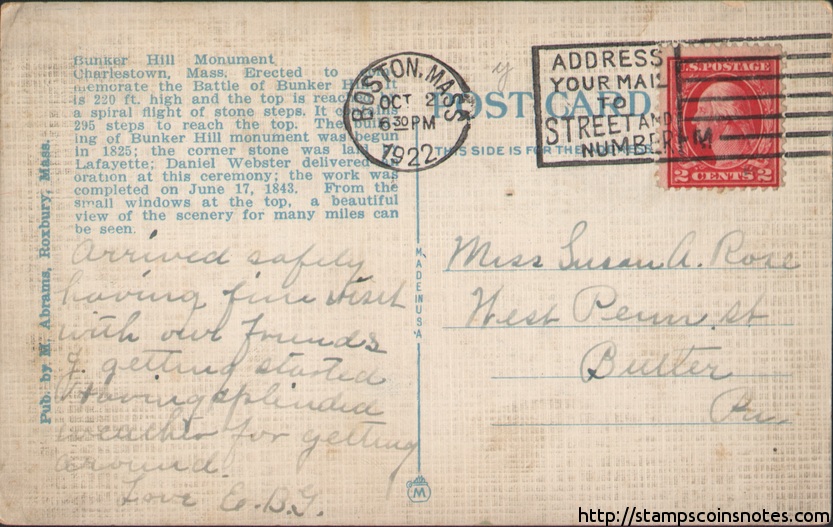
In the 1920’s some post offices encouraged senders to write street addresses on mail. An example can be found here on this postcard from 1922 with a postmark reading “Address your mail to street and number”:
In 1943, due to a shortage of experienced postal carriers caused by World War II, postal zones were created. They were intended to make sorting and delivery easier within the 178 most populous areas of the United States. A typical address would then read:
Reginald Doe
1123 Main St.
Long Beach 3, California
In 1963, the “Zone Improvement Plan” was created based on a 1944 proposal by the postal inspector Robert Moon. It is a system of five-digit codes used for routing mail to a more specific location. This plan made use of the existing postal zone codes, using three prefix digits in conjunction with the existing postal zone. The previous “Long Beach 3” postal zone became ZIP code 90803.
The first digit of a ZIP code generally indicates how far west a location is. States on the east coast have zip codes beginning in 0, while Pacific states have zip codes beginning with 9. The 0 prefix was also used for U.S. Territories such as Puerto Rico and the Virgin Islands.
At the same time, the post office started encouraging the use of two-letter state codes. The theory was that compressing the name of the state would make it easier to make room for the five-digit ZIP.
In 1967 the ZIP code was made mandatory for bulk mailers of 2nd and 3rd class material.
In 1983 the nine-digit ZIP+4 was created. This includes more specific location data with the first two digits being “sector”, such as a group of streets or high-rise building, and the second two being “segment”, such as a specific city block or floor of a skyscraper.
For post office boxes, each box has its own unique +4 code. In the case of box numbers with four or fewer digits, this is simply the box number.
The ZIP+4 scheme has not been widely adopted for non-commercial mail and is not required, but it is used extensively by postal processing and sorting equipment. Bulk mailers receive a discount on postage if they pre-print the postnet barcode for the extended ZIP code on their mail.
Though intended primarily for mail routing, the 42,000+ zip codes are used for statistical aggregation by the Census Bureau and are used extensively by business for marketing and customer data aggregation purposes. It is also very common to see real estate data aggregated by zip code.
State Quarters
From 1999 to 2008 the United States Mint issued state-themed quarters. Five states were issued per year in the order in which they achieved statehood. After the state series was completed, quarters for the U.S. territories were issued in 2009. Each of the state quarters was issued from both the Denver and Philadelphia mints, making a total of 100 quarters in the full set.
Here is a list of the state quarters, with date of statehood in parentheses:
1999
Delaware (1787-12-07)
Pennsylvania (1787-12-12)
New Jersey (1787-12-18)
Georgia (1788-01-02)
Connecticut (1788-01-09)
2000
Massachusetts (1788-02-06)
Maryland (1788-04-28)
South Carolina (1788-05-23)
New Hampshire (1788-06-21)
Virginia (1788-06-25)
2001
New York (1788-07-26)
North Carolina (1789-11-21)
Rhode Island (1790-05-29)
Vermont (1791-03-04)
Kentucky (1792-06-01)
2002
Tennessee (1796-06-01)
Ohio (1803-02-19)
Louisiana (1812-04-30)
Indiana (1816-12-11)
Mississippi (1817-12-10)
2003
Illinois (1818-12-03)
Alabama (1819-12-14)
Maine (1820-03-15)
Missouri (1821-08-10)
Arkansas (1836-06-15)
2004
Michigan (1837-01-26)
Florida (1845-03-03)
Texas (1845-12-19)
Iowa (1846-12-28)
Wisconsin (1848-05-29)
2005
California (1850-09-09)
Minnesota (1858-05-11)
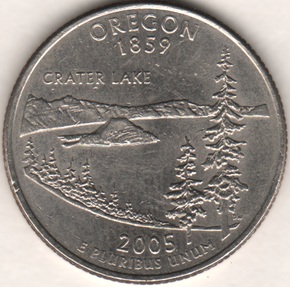
Oregon (1859-02-14)
Kansas (1961-01-29)
West Virginia (1863-06-20)
2006
Nevada (1864-10-31)
Nebraska (1867-03-01)
Colorado (1876-08-01)
North Dakota (1889-11-02)
South Dakota (1889-11-02)
2007
Montana (1889-11-08)
Washington (1889-11-11)
Idaho (1890-07-03)
Wyoming (1890-07-10)
Utah (1896-01-04)
2008
Oklahoma (1907-11-16)
New Mexico (1912-01-06)
Arizona (1912-02-14)
Alaska (1959-01-03)
Hawaii (1959-08-21)
2009
District of Columbia
Puerto Rico
Guam
America Samoa
Virgin Islands
Northern Mariana Islands